Protests took place in Tel Aviv, Jerusalem, Haifa, and Beersheba, as a survey found broad but uneven support among Jewish Israelis for Operation Roaring Lion.
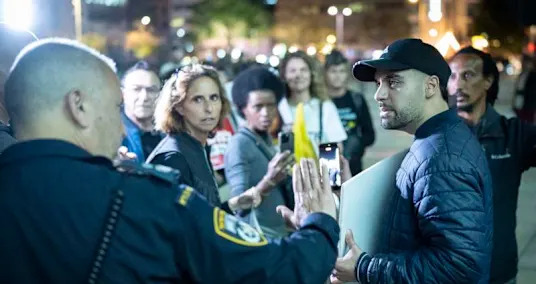
Israel Police arrested 21 anti-war protesters Saturday night as demonstrations against the conflict with Iran expanded in multiple cities despite restrictions on public gatherings.
Protests took place in Tel Aviv, Jerusalem, Haifa, and Beersheba, with hundreds of participants reported in Tel Aviv and Jerusalem and about 100 in Haifa, marking the largest turnout since weekly demonstrations began. Authorities said 13 people were arrested in Tel Aviv and eight in Haifa.
Police said the gatherings were not approved under Home Front Command regulations that ban events with more than 50 people. Officials said the increase in turnout followed calls by groups opposing the government to protest despite the restrictions.
“During a situation assessment that took place at the scene with a Home Front Command representative… it was clarified that there was a real risk to human life and accordingly, Yarkon [precinct] police commander Tzachi Sharabi ordered the gathering to be dispersed,” police said.
Hadash-Ta’al chairman Ayman Odeh, an Arab lawmaker involved in the protests, criticized the police response, calling officers fascists “in the service of the government” and saying they were afraid of “the heroic citizens who went out, despite everything, to make their voice heard.”

Survey shows broad, uneven support for war
The demonstrations come as a March 2026 survey by the Israel Democracy Institute found broad but uneven support among Jewish Israelis for Operation Roaring Lion. Support was strongest on the Right at 87% and about half on the Left.
The survey also found that Jewish and Arab respondents largely agreed that Iran’s resilience has been stronger than expected. Most Jewish respondents said Israeli society could sustain the campaign for up to one month, while 28% said as long as needed. Arab respondents were less optimistic about how long the public could endure the conflict.
A majority of Jewish respondents said Prime Minister Benjamin Netanyahu’s decision was driven by security considerations, while most Arab respondents viewed it as political.
LATEST POSTS
- 1
 A Manual for SUVs with Less Noteworthy Gas Mileage
 - 2Tesla Germany Registrations Quadruple to 9,252 Vehicles in Best March Ever
- 3A 'Stranger Things' documentary covering the final season is on its way: Watch the trailer
- 4Are IDF reservists properly armed during post-war operations?
- 5New COVID-19 variant 'Cicada' is spreading. What to know about BA.3.2.





- Addressing sleep apnea early might decrease chances of developing Parkinson's disease
- Conquering Social Generalizations: Individual Accounts of Strengthening
- Explosions at Burundi ammunition depot kill civilians, witnesses say
- Wellness Bits of knowledge Readily available: A Survey of \Following Wellbeing and Progress\ Wellness Wearables
- Israeli strikes on Beirut, as Hezbollah and Iran attack Israel
- This St Nick Truly Can Advise How To Drink And Hack Your Headache
- We may have less control over how long we live than previously thought
- Toyota Reports 2.3% Sales Drop as China Weakness Deepens
- 'Israel has the right to continue its attacks,' Lebanese Foreign Minister announces